
Family Game Night Rules That Keep Everyone Happy (And Actually Coming Back)

Hess P
Parent tester & co-founder of CoPlayConnect
Family game night sounds simple. Pick a game, sit down together, have fun.
Then someone flips the board. Or one child quits mid-game. Or the oldest player dominates every round while the youngest tunes out. Or nobody can agree on which game to play, and the whole evening collapses before it starts.
Sound familiar?
Here's what most parenting advice gets wrong about family game night: it focuses on which games to play and skips the part that determines whether the night actually works — the rules around how you play.
Not game rules. Family rules. The expectations, boundaries, and agreements that turn a chaotic evening into a consistent ritual your kids genuinely look forward to.
This is your guide to building those rules — and understanding why they matter far beyond game night itself.
Why Family Game Night Rules Matter
Rules might sound like the opposite of fun. But without them, game night is just managed chaos.
The families who build lasting game night traditions — the ones where kids are asking "is it game night tonight?" by Wednesday — all have one thing in common: they've created a framework that makes the experience feel safe, fair, and predictable. That framework is made up of simple, consistent rules that everyone understands before the game starts.
There's a deeper reason these rules matter too. Game night is one of the few environments where kids practice real emotional and social skills — turn-taking, handling disappointment, communicating under pressure, collaborating with people who think differently than they do. The rules you set don't just govern the game. They shape how your child learns to show up in the world.
At CoPlayConnect, Emotional Growth and Real-Life Transfer are two of the four pillars in our Connection Grade™ evaluation. That's because we believe the best gaming experiences don't just entertain — they build something lasting. The right family rules are what activate that potential.
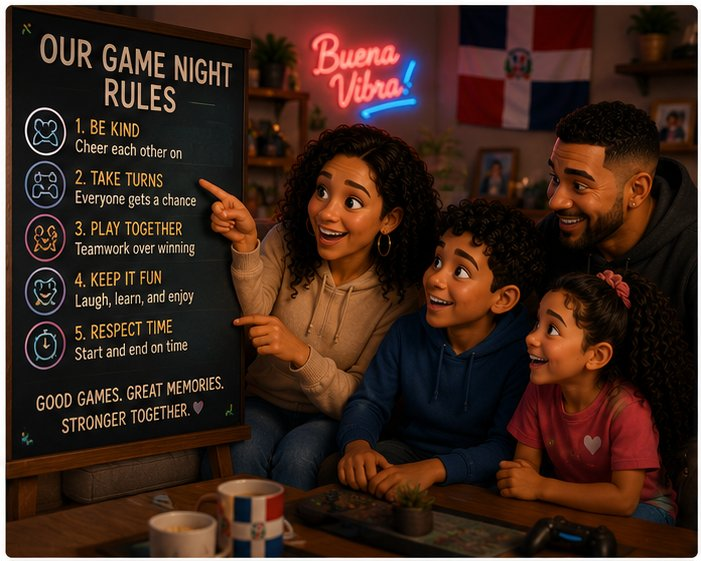
Rule #1: Agree on the Game Before Anyone Sits Down
One of the most common reasons game night falls apart has nothing to do with the game itself. It starts in the five minutes before you play — when everyone is lobbying for their favorite and nobody can agree.
Set a simple rule: the game is chosen before game night officially starts. Rotate whose turn it is to pick each week, post it somewhere visible, and honor the choice without negotiation once it's made.
This does two things. First, it eliminates the debate that drains energy before a single card is drawn. Second, it teaches kids one of the most important real-world skills there is: going along with a group decision graciously, even when it wasn't your pick.
If you want to take it further, use GameMatch Arcade™ to find games matched to your family's goals and your child's interests ahead of time. Having two or three pre-approved options ready makes the rotation feel fair rather than forced.
Rule #2: Learn the Rules Together Before You Play
Nothing derails game night faster than a rules dispute mid-game. "That's not how you do it." "Yes it is." "Dad, tell him."
Make it a house rule: everyone hears the rules before the first move. Not just the person who's played before — everyone. This levels the playing field, eliminates mid-game arguments, and gives younger players a fair shot from the start.
For complex games, consider a practice round with no stakes before the real game begins. For video games especially, make sure the tutorial is complete and every player understands the controls before the competitive pressure starts.
This rule also signals something important to your kids: we prepare before we compete. That's a life skill, not just a game night tip.
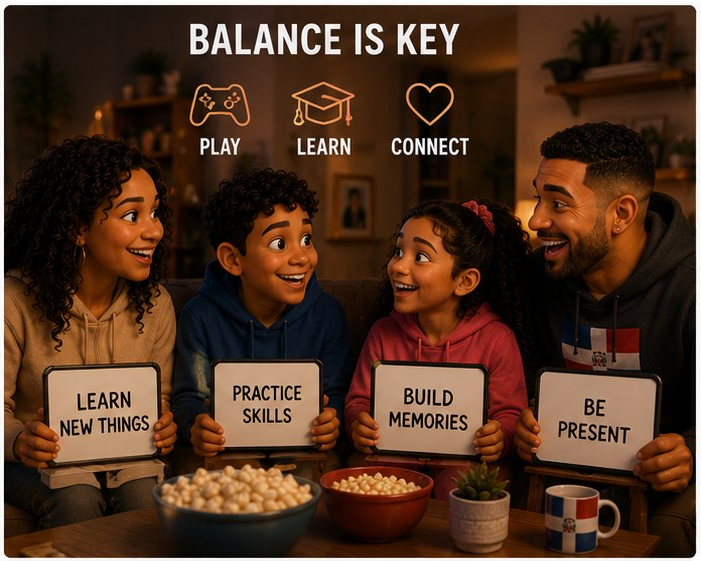
Rule #3: Set Clear Expectations Around Winning and Losing
This is the rule most families skip — and the one that prevents the most conflict.
Before the game starts, name it out loud: we play to have fun and connect, not just to win. Then go further. Talk specifically about what winning and losing should look like in your family.
Some questions worth answering together before you play:
- What do we say when we win? (Celebrating is fine. Gloating isn't.)
- What do we do when we lose? (Feeling disappointed is okay. Blaming others or quitting isn't.)
- What happens if someone gets really frustrated? (Take a short break. Reset. Come back.)
These conversations feel small in the moment. Over time, they're some of the most important ones you'll have with your kids. You're not just setting game night expectations — you're building the emotional vocabulary they'll use in classrooms, friendships, and eventually workplaces.
Emotional regulation through play isn't a bonus feature of game night. For intentional parents, it's one of the primary reasons to play at all.

Rule #4: Phones Away, Presence On
This one is non-negotiable — and it applies to parents too.
Set a house rule that devices go face-down (or in another room) for the duration of game night. Not on the table. Not "just in case." Away.
This sounds simple. It's harder than it looks, especially for parents who are used to being reachable. But the message it sends your child is profound: this time with you is more important than whatever else is on that screen.
That message — repeated week after week — is one of the strongest foundations of family connection you can build. It's also, not coincidentally, exactly what CoPlayConnect's mission is built on: turning screen time into shared time, not eliminating screens, but being intentional about when and how they're used.
Healthy gaming habits for families don't come from restricting screens. They come from modeling what it looks like to be fully present when it counts.
Rule #5: Everyone Participates — But Participation Looks Different
Not every child engages the same way. One kid is fully in. Another hangs back. A younger sibling wants to help but can't keep up with the strategy. An older child is bored by anything too simple.
The rule here is: no one is forced out, and no one is left out.
For mixed-age families, this means building flexible participation into your game night structure. A younger child can roll dice or manage tokens while an older sibling handles strategy. A hesitant player can watch a round before joining. A child who needs a break can step away and return without penalty.
The goal is to lower the barrier to participation — not raise the pressure to perform. When kids feel safe to engage at their own level, they're far more likely to show up willingly and stay engaged longer.
This is also where Parent-Approved game discovery becomes a real asset. Choosing games that are genuinely rated and evaluated for your family's age range — not just a generic age label on a box — means you're starting from a place where participation is actually possible for everyone at the table.
Rule #6: Honor the Ritual, Not Just the Game
The families who get the most out of game night treat it as a ritual, not just an activity. And rituals have structure: a consistent beginning, a middle with shared focus, and a closing that signals it meant something.
Opening: Take two minutes before you play. Ask everyone what kind of night they need — silly, competitive, chill. Let each person share one high and one low from the week. This costs almost nothing and shifts the energy in the room from scattered to connected.
During: Use the natural pauses in gameplay for real conversation. "What would you do differently next round?" "How did that feel when it worked?" These aren't forced — they arise naturally when the parent is paying attention and willing to lean in.
Closing: End with a quick debrief. What was the funniest moment? What was hardest? What game should we play next time? This closing ritual tells kids: what just happened mattered. We were here together, and it was worth doing.
These conversation starters and connection moments are where the real bonding happens — not during the gameplay itself, but in the texture around it.
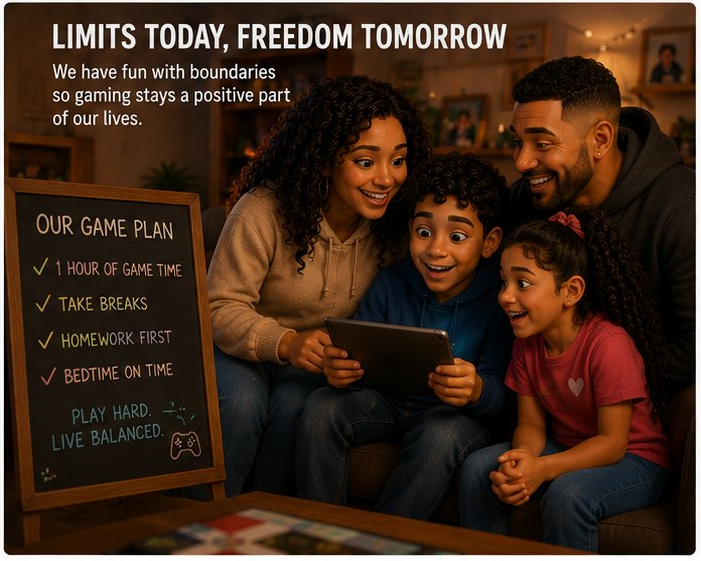
Rule #7: Protect the Schedule
The most important rule of all is also the simplest: show up.
Game night only builds into a family ritual when it's consistent. That doesn't mean rigid — life is full. But it does mean protected. If game night is the first thing that gets dropped when the week gets busy, it never becomes part of your family's identity.
Pick a time window that works for your real life — Friday after dinner, Sunday afternoon, a short Wednesday session before bedtime. Put it on the calendar. Keep it most weeks. Let your kids see you protect it.
Over time, the message lands: this family makes time to play together. That's not a small thing. For a child growing up in a world full of competing demands and distracted adults, knowing that their parent consistently shows up for game night is an anchor they'll carry far longer than they'll remember any specific game you played.
Building Your Family's Game Night Rules Together
The most effective rules aren't ones parents impose — they're ones families build together. Consider sitting down as a family before your next game night and asking: what would make this better for everyone?
Let kids contribute. Let them name what feels unfair or frustrating. Let them help design the structure. When children have a hand in creating the rules, they're far more invested in honoring them.
At CoPlayConnect, everything we build — from Connection Grade™ game evaluation to Family Game Night Planning tools — is designed to help parents lead this experience with confidence. Not as referees enforcing rules, but as architects of something their family will genuinely love.
The rules you set for game night aren't restrictions. They're the structure that makes connection possible.
Set the rules. Protect the time. Show up fully.
That's it. That's the whole formula.
Ready to find your family's next great game? Use GameMatch Arcade™ on CoPlayConnect to discover Parent-Approved games evaluated through the Connection Grade™ — matched to your family's goals, your child's age, and the kind of night you want to create.