
Can Video Games Help Kids Learn? The Answer Might Surprise You

Hess P
Parent tester & co-founder of CoPlayConnect
CoPlayConnect is an Amazon Associate. We earn from qualifying purchases — at no extra cost to you. Affiliate Disclosure
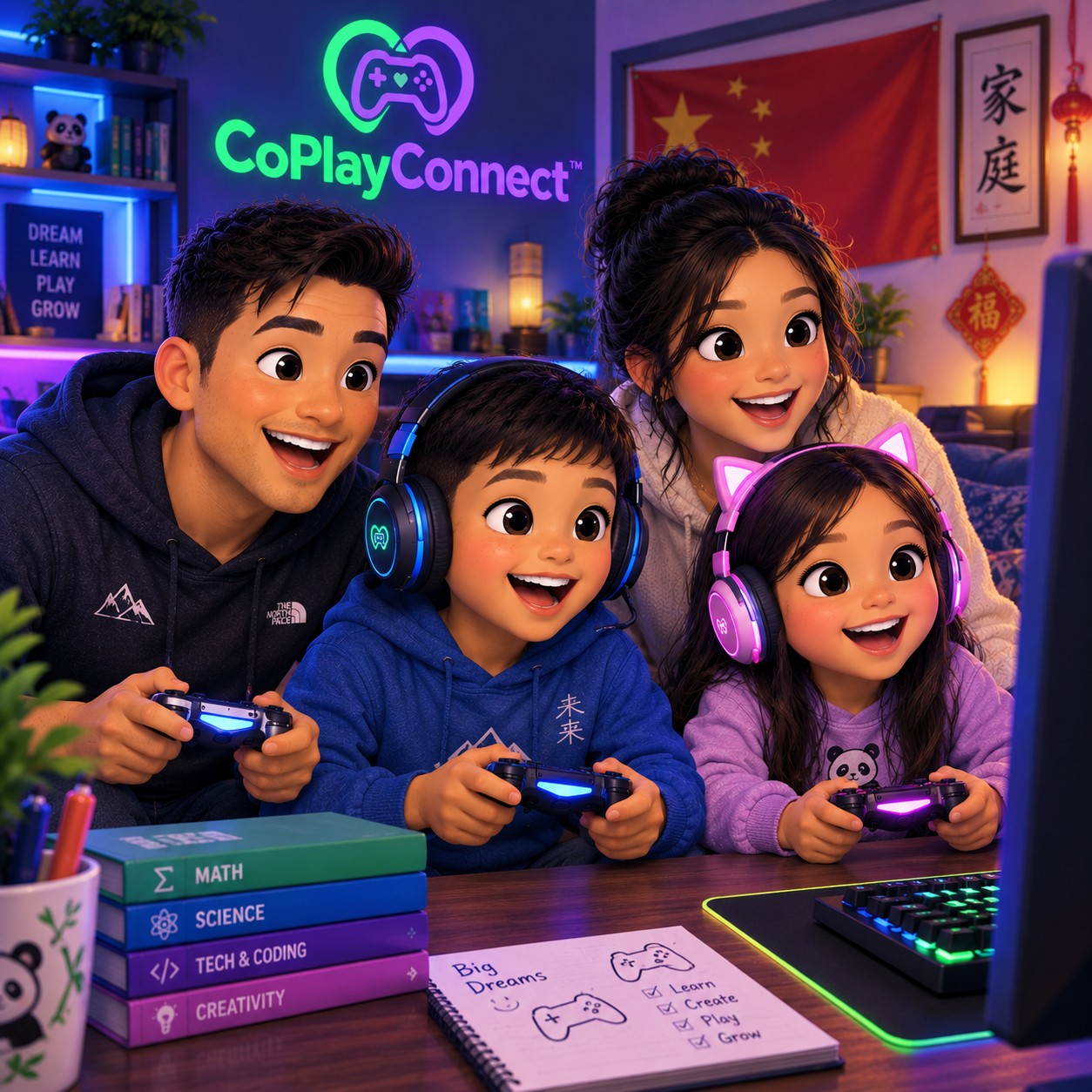
Ask most parents whether video games help kids learn and you'll get a skeptical look. Gaming has spent decades carrying a reputation as the thing kids do instead of learning — the distraction, the time sink, the battle at homework time.
But ask a researcher? The answer is very different.
A growing body of evidence shows that video games — when chosen intentionally — are among the most effective tools available for developing the cognitive, emotional, social, and creative skills children need to thrive. Not just in school. In life. And in the careers they'll build decades from now.
The real question was never can video games help kids learn. It was always: which games, played which way, with whose guidance?
That's the question CoPlayConnect was built to answer.
What the Research Actually Says
The science on gaming and learning has shifted dramatically over the last two decades. Early research focused almost exclusively on potential harms — violence, addiction, attention span. More recent, methodologically stronger studies tell a more complete story.
A landmark study published in Psychological Science found that action video game players demonstrated significantly enhanced visual attention, pattern recognition, and the ability to track multiple objects simultaneously — skills that transfer directly to fields like surgery, aviation, engineering, and data analysis.
Research from the American Psychological Association found that playing video games — including shooter games — was associated with improved problem-solving, creativity, and social skills. The key variable wasn't the game type. It was the context, duration, and level of parental involvement.
A 2019 study from Columbia University's Mailman School of Public Health found that children who played video games for three or more hours per day showed higher cognitive function scores — in attention, memory, and processing speed — compared to non-gaming peers.
None of this means all gaming is equally valuable. It means intentional gaming, with the right games, has genuine developmental power. And that's exactly the distinction CoPlayConnect's Connection Grade™ was built to make — specifically through its Learning pillar, which evaluates how much cognitive and educational value a game genuinely delivers.
What Video Games Actually Teach Kids
When parents look past the surface of what their child is playing, they often find a surprisingly rich learning environment. Here's what's actually happening inside the games kids love:
Critical Thinking and Problem Solving
Almost every meaningful video game requires players to analyze a situation, form a hypothesis, act on it, and adjust when the outcome isn't what they expected. That loop — observe, hypothesize, test, adapt — is the scientific method. It's also the foundation of every career that requires analytical thinking.
Strategy games like Civilization, puzzle games like Portal, and survival games like Minecraft put this loop at the center of every session. Kids who play these games regularly develop a natural comfort with complexity, ambiguity, and iterative problem-solving that many structured educational environments struggle to replicate.
Creativity and Design Thinking
Games that give players the tools to build, design, and create — Minecraft, Super Mario Maker 2, Dreams, Roblox — develop something that's increasingly rare and valuable: the ability to imagine something that doesn't exist yet and build a path to make it real.
This is design thinking. It's the skill that sits at the heart of architecture, product development, game design itself, content creation, and entrepreneurship. And children develop it naturally, joyfully, and at their own pace inside a well-chosen sandbox game.
Collaboration and Communication
Multiplayer and co-op games require players to communicate under pressure, divide responsibilities, adapt to teammates' strengths and weaknesses, and recover from failure as a group. These aren't just game skills. They're workplace skills. They're life skills.
Games like It Takes Two, Pikmin 3 Deluxe, and Overcooked are built entirely around these dynamics — and the communication patterns they develop in children are directly transferable to team projects, group work, and eventually professional collaboration.
Emotional Regulation and Resilience
Every game eventually puts a player in a position of failure. A lost level, a failed strategy, a comeback that doesn't happen. How a child responds to those moments — and how they're guided through those responses — is where some of the most important learning happens.
Kids who game regularly in a supportive family environment develop a higher tolerance for frustration, a stronger ability to regulate emotional responses, and a more resilient relationship with failure. They learn that losing is information, not identity. That you can try again. That persistence matters more than perfection.
These are emotional intelligence skills. And employers, educators, and mental health professionals have been calling them the defining skills of the next generation.
Financial Literacy and Resource Management
Many games that seem purely fun are quietly teaching economic principles. Stardew Valley requires players to budget resources, manage a farm economy, make investment decisions, and balance short-term needs against long-term goals. Animal Crossing introduces concepts of debt, savings, real estate, and market fluctuation. Minecraft teaches resource scarcity and value.
These aren't accidental. Game designers build these systems intentionally. And children absorb them — often before they've had a single formal lesson in personal finance.
From Game Skills to Career Pathways: What CoPlayConnect Sees That Others Miss
Here's where CoPlayConnect goes further than any other family gaming platform.
Every game in the CoPlayConnect library includes a dedicated Career Pathways section inside its game detail page. This feature takes the skills a child develops inside a specific game and maps them directly to real-world career fields they could pursue — years or even decades from now.
This matters enormously. Not because children should be pressured to choose careers based on their game preferences. But because when a parent can look at their child playing Minecraft and say — "the spatial reasoning and architectural design you're practicing right now is the same skill set that architects, engineers, and urban planners use every day" — something shifts.
The child feels seen. The parent feels informed. And gaming transforms from something the family tolerates into something the family celebrates.
Here's how that Career Pathways connection looks across some of the games in the CoPlayConnect library:
- Minecraft → Architecture, Civil Engineering, Urban Planning, Game Design, 3D Animation, Environmental Science
- Super Mario Maker 2 → Game Design, UX/UI Design, Software Development, Education, Creative Direction
- Stardew Valley → Agriculture, Business Management, Financial Planning, Environmental Science, Entrepreneurship
- It Takes Two → Psychology, Counseling, Team Leadership, Project Management, Human Resources
- Alba: A Wildlife Adventure → Wildlife Biology, Environmental Law, Conservation Science, Nonprofit Leadership, Journalism
- Pikmin 3 Deluxe → Military Strategy, Operations Management, Logistics, Systems Engineering, Project Coordination
This is what the Real-Life Transfer pillar of the Connection Grade™ measures — and why CoPlayConnect treats it as one of the four foundational pillars of every game evaluation. A game isn't just entertainment. It's practice. And practice, done consistently over time, builds expertise.
How to Use Gaming as a Learning Tool at Home
Knowing that video games can teach isn't enough. The learning is activated — or missed — based on what happens around the game.
Play alongside your child.
The single most powerful way to unlock the learning potential of any game is to be present in it. Ask questions. Notice what your child figures out. Celebrate the problem they solved, not just the level they beat. Your attention signals that what they're doing has value.
Connect the game to the real world.
After a session of Stardew Valley, ask: "If you were really running a farm, what would you do differently?" After Minecraft, say: "What you just built uses the same thinking architects use." These bridges — from game to real life — are where the learning cements.
Use CoPlayConnect's game detail features.
Every game page on CoPlayConnect gives you the tools to do this naturally. The Real-Life Skills section shows you exactly what a game is developing. The Career Pathways section maps those skills to future possibilities. The Connection Moments section gives you ready-made conversation starters for during and after gameplay. The Busy Parent Summary tells you everything you need to know — Time Required, Best For, Safety Level, and Great for Your Child — in under thirty seconds.
You don't need a background in education or child psychology to use gaming as a learning tool. You need the right information at the right moment. That's what CoPlayConnect puts in every parent's hands.
Reflect after game night.
Build a short closing ritual that invites reflection: "What was the hardest part tonight?" "What did you figure out that you didn't know before?" "What would you do differently next time?" These questions take two minutes. The thinking skills they reinforce last a lifetime.
The Shift Every Parent Can Make Today
The question "can video games help kids learn?" has a clear answer now: yes, absolutely — with the right games, the right context, and an engaged parent who knows what to look for.
The shift isn't from more gaming to less gaming. It's from passive gaming to purposeful gaming. From screen time as a default to screen time as a decision. From a parent watching from a distance to a parent who knows exactly what their child is building — and can celebrate it.
CoPlayConnect exists to make that shift as easy as possible. Every game in our library is evaluated through the Connection Grade™ — scored across Connection, Learning, Emotional Growth, and Real-Life Transfer. Every game detail page gives you Co-Play Tips, Connection Moments, Real-Life Skills, Career Pathways, and a Busy Parent Summary so you can make confident decisions in seconds, not hours.
Because your child is already learning inside their favorite games. The only question is whether you know what they're learning — and whether you're there to help them make the most of it.
They're building something. Make sure you're building it with them.
Ready to discover what your child's favorite games are really teaching them? Search any game on CoPlayConnect and explore Career Pathways, Real-Life Skills, and Connection Moments — all in one place.
Written by the CoPlayConnect Team
We help parents find, evaluate, and play games that bring families closer together. Every recommendation is backed by our Connection Grade™ methodology.
Want to see what your child's games are really teaching?
Join CoPlayConnect and explore Career Pathways, Real-Life Skills, and Connection Moments for every game in our library — so you can make confident decisions in seconds.
Related Articles
Game Discovery
Parent-Approved Video Games
How to know what's actually worth your family's time.
Family Gaming
Benefits of Family Game Night
It's more than just fun — here's what the research says.
Healthy Gaming
Healthy Gaming Habits for Families
A guilt-free guide for parents who actually play.
Family Gaming
Family Game Night Tips
Practical tips that actually work, even on hard weeks.