
Healthy Gaming Habits for Families: A Guilt-Free Guide for Parents Who Actually Play

Hess P
Parent tester & co-founder of CoPlayConnect
CoPlayConnect is an Amazon Associate. We earn from qualifying purchases — at no extra cost to you. Affiliate Disclosure
If gaming in your home feels like a constant negotiation — over how long, what game, whose turn, and why it's time to stop — you're not alone. And you're not failing as a parent.
The tension most families feel around gaming isn't a sign that screens are the problem. It's a sign that the habits around gaming haven't been built yet.
That's a very different problem. And it has a very different solution.
Healthy gaming habits for families aren't about restriction. They're about intention. When families are clear about how they game, what they game, and why they game together, the conflict fades — and something much more valuable takes its place.
This is the guide CoPlayConnect was built to support. Here's everything you need to build gaming habits your whole family can feel good about.
Gaming Isn't the Enemy — But Unstructured Gaming Can Be
Let's be honest about something most parenting content dances around: gaming itself is not harmful. Decades of research consistently show that gaming — especially when done in moderation and with intentional game selection — supports cognitive development, emotional growth, creativity, and social connection.
The risks are real too. Excessive, unstructured gaming with no boundaries, no parental involvement, and no consideration for what a child is actually experiencing inside a game — that's where problems develop. Sleep disruption, social withdrawal, emotional dysregulation, and passive consumption without meaningful engagement are all outcomes of gaming without guardrails.
The difference between gaming that helps and gaming that hurts almost always comes down to one thing: intentionality.
Intentional gaming means knowing what your child is playing, why they're playing it, how long they're playing, and — whenever possible — playing alongside them. That's the foundation every healthy gaming habit is built on. And it's exactly what CoPlayConnect was designed to make easier.

Healthy Gaming Habit #1: Choose Games With Purpose, Not Just Permission
The first and most impactful healthy gaming habit isn't about time limits. It's about game selection.
Most parents approach game approval reactively — a child asks for a game, the parent Googles it, skims a few reviews, checks the ESRB rating, and makes a judgment call. That process is exhausting, inconsistent, and often leaves parents still unsure whether they made the right call.
Choosing games with purpose means asking better questions before a game enters your home:
- Does this game create opportunities for us to play together?
- What is my child actually learning inside this game?
- How does this game handle frustration, failure, and competition?
- Will the skills my child builds here transfer to real life in any meaningful way?
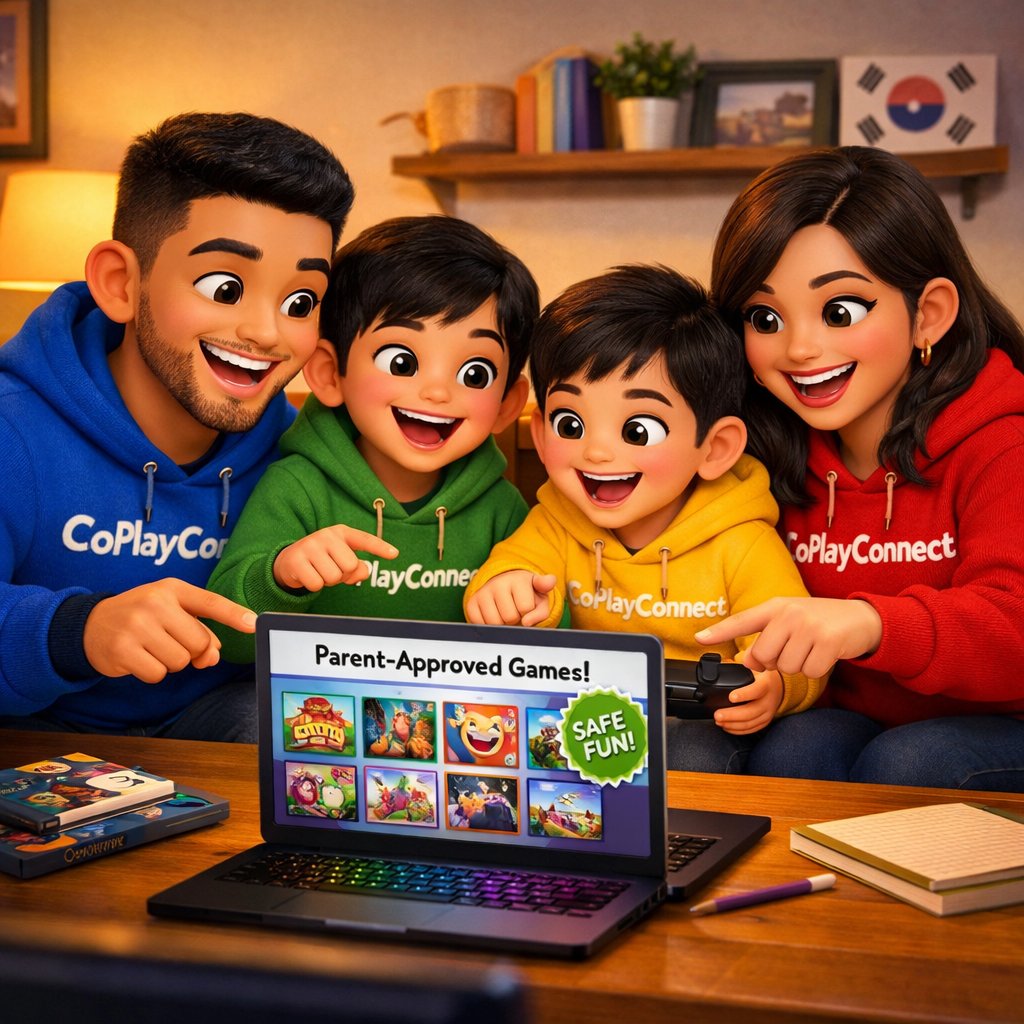
These are the exact four questions behind CoPlayConnect's Connection Grade™ — the evidence-based evaluation framework that scores every game across Connection, Learning, Emotional Growth, and Real-Life Transfer. A game that earns a B or higher across all four pillars receives the Parent-Approved designation — meaning it isn't just safe, it's genuinely worth your family's time.
When game selection starts from this foundation, the entire dynamic around gaming shifts. Instead of fighting over whether a game is allowed, families can have conversations about what makes a game worth playing. That's a fundamentally different relationship with screens — and it starts with one intentional decision.
Healthy Gaming Habit #2: Set Time Boundaries That Work With Your Family, Not Against It
Screen time limits are the most debated topic in family gaming — and also the most misunderstood.
The American Academy of Pediatrics moved away from rigid hour-based limits years ago, shifting toward a quality-and-context framework: what matters isn't just how much, but what, how, and with whom. That shift reflects what research increasingly shows — that an hour of isolated, passive gaming looks very different developmentally from an hour of co-op gaming with a parent actively engaged alongside their child.
That said, boundaries matter. Here's how to set them in a way that actually sticks:
- Make the limit predictable, not punitive. Instead of "you've been on too long, turn it off now," try "we do one hour of gaming on school nights and two on weekends." When kids know the boundary before they start, they're less likely to fight it when it arrives.
- Use natural stopping points. Games have levels, missions, and save points. Stopping mid-mission feels arbitrary and frustrating — stopping at the end of a round feels fair. Work with the game's structure instead of against it. A five-minute warning before the end of game night helps kids transition without the shutdown feeling like a punishment.
- Connect gaming time to responsibility. Homework done, chores complete, family time honored — then gaming. This isn't a punishment framework. It's a sequencing framework that teaches kids that gaming is a reward that follows responsibility, not a default activity that fills all available time.
- Review and adjust regularly. What works for a six-year-old won't work for a twelve-year-old. Revisit your family's gaming boundaries as your kids grow and their needs change. The goal isn't a permanent rule — it's a living agreement that fits your family's real life.
Healthy Gaming Habit #3: Play Together — Even If You're Not a Gamer
This is the habit that changes everything — and the one most parents skip because they don't think it applies to them.
You don't have to be good at video games to play with your child. You don't have to understand the mechanics, win any matches, or keep up with what's happening on screen. What you have to do is show up and be present.
When parents play alongside their children — even badly, even briefly — several things happen simultaneously:
- Gaming becomes associated with connection rather than isolation
- Children feel seen and validated in something they love
- Parents gain firsthand knowledge of what their child is actually experiencing
- Natural conversation opportunities emerge that wouldn't happen any other way
- The game itself becomes a shared language between parent and child
Co-op games are the easiest entry point for parents who aren't experienced gamers. Games like It Takes Two, Pikmin 3 Deluxe, Minecraft, and Stardew Valley are built for players of different skill levels to enjoy together — the experienced player carries more of the load while the newer player participates meaningfully. Nobody feels left out, and nobody has to pretend to be something they're not.
GameMatch Arcade™ on CoPlayConnect makes finding these games easy. Answer a few questions about your child's interests, age, and your family's goals — and GameMatch Arcade™ generates a personalized list of Parent-Approved games matched specifically to your family. No more guessing. No more hoping the game you picked will work. Just confident, curated recommendations you can trust.
Healthy Gaming Habit #4: Create a Positive Gaming Environment at Home
The physical and emotional environment around gaming shapes the habit as much as the games themselves.
- Designate a gaming space. Whether it's the living room TV, a dedicated desk, or a shared family area — having a consistent, visible gaming space keeps gaming out of bedrooms (where monitoring is harder and sleep disruption more likely) and in shared spaces where parents can naturally observe without hovering.
- Keep gaming social. Multiplayer and family games in shared spaces make gaming a communal activity rather than a solitary one. Even when your child is playing alone, being in a shared space means they're still part of the household rather than isolated in their room.
- Talk about games openly. Create a culture where your child feels comfortable telling you what they're playing, what happened in the game, and what they enjoy about it. Ask curious questions — "what did you build today?" or "how far did you get?" — rather than interrogating questions. When kids feel safe talking about gaming, parents stay naturally informed without having to monitor.
- Model what you want to see. If you want your child to put the controller down when asked, demonstrate that you can put your own devices down at the dinner table. If you want your child to take breaks, take them yourself. The habits you model will always be more powerful than the rules you enforce.
Healthy Gaming Habit #5: Use Gaming as a Window Into Your Child
One of the most underused opportunities in family gaming is the insight it offers into who your child is becoming.
Watch how your child handles losing. Do they recover quickly or shut down? Watch how they approach a hard puzzle — do they persist or give up? Notice what kinds of games they gravitate toward — strategy, creativity, narrative, competition? These patterns reveal personality traits, emotional tendencies, and natural strengths that don't always show up in school or structured activities.
The Emotional Growth and Real-Life Transfer pillars of the Connection Grade™ exist precisely because CoPlayConnect believes gaming is a window, not just an activity. A child who thrives in building games like Minecraft may have a natural aptitude for design, engineering, or architecture. A child who leads naturally in team-based games may have real leadership instincts worth developing. A child who gravitates toward story-driven games may be a natural storyteller, empath, or future writer.
When parents pay attention to these patterns — and affirm what they see — gaming becomes one of the richest conversations a family can have. "I noticed you never quit even when it got really hard. That's persistence, and it shows up outside of games too." That kind of reflection is worth far more than any single game night.
Healthy Gaming Habit #6: Make Game Night a Non-Negotiable Ritual
The most powerful healthy gaming habit of all isn't a rule. It's a rhythm.
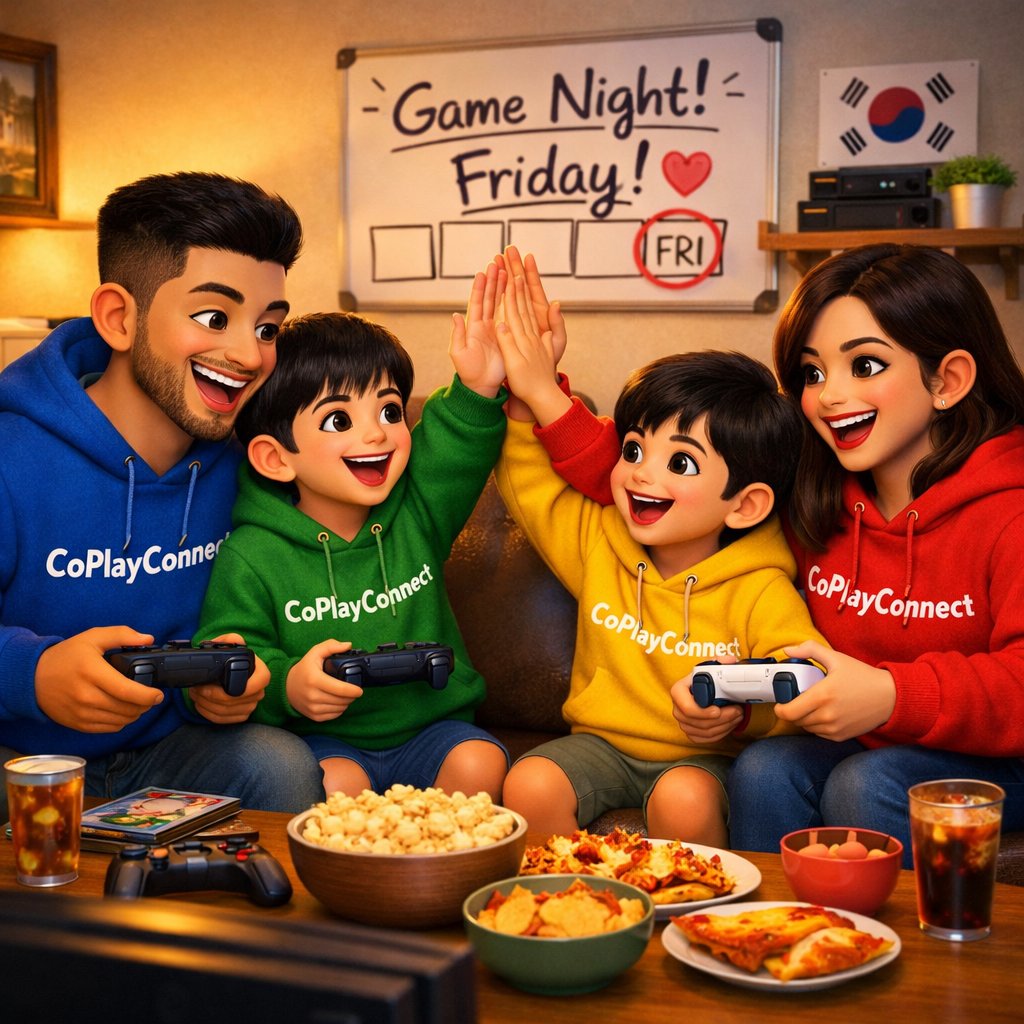
Families who build a consistent game night ritual — same general time, same general structure, protected from the week's chaos — report stronger family bonds, better communication, and kids who are more willing to accept gaming boundaries the rest of the week. The reason is simple: when kids know that gaming with the family is a guaranteed, recurring experience they can look forward to, they stop treating every gaming session like it might be their last.
Game night doesn't need to be elaborate. It needs to be consistent. Thirty to forty-five minutes on a Friday evening, a Sunday afternoon session, a short mid-week check-in — whatever fits your family's rhythm. The key is protecting it like it matters, because it does.
CoPlayConnect's Game Night Planning tools help families take the friction out of preparation — from choosing a game that fits your goals for the night, to generating conversation starters that turn play into genuine connection. Because the goal was never just to play. It was always to connect.
The Simplest Truth About Healthy Gaming Habits
Healthy gaming habits don't come from stricter rules or more monitoring. They come from more presence.
When parents are present — in the games they choose, in the time they protect, in the sessions they join, and in the conversations they invite — gaming transforms from a source of household tension into one of the most reliable tools for family connection available.
That's the vision CoPlayConnect was built on. Not fear of screens. Not guilt about gaming. Just the belief that when families play together with intention, something genuinely good happens.
The screen isn't the problem. The presence is the point.
Ready to build healthier gaming habits starting tonight? Use GameMatch Arcade™ to find Parent-Approved games matched to your child's interests and your family's goals — evaluated through the Connection Grade™ so you know exactly what you're choosing.
Written by the CoPlayConnect Team
We help parents find, evaluate, and play games that bring families closer together. Every recommendation is backed by our Connection Grade™ methodology.
Want more family gaming insights?
Join CoPlayConnect and discover Parent-Approved games, plan your next game night, and build healthier gaming habits with your family.
Related Articles
Game Discovery
Parent-Approved Video Games
How to know what's actually worth your family's time.
Family Gaming
Benefits of Family Game Night
It's more than just fun — here's what the research says.
Family Gaming
Family Game Night Tips
Practical tips that actually work, even on hard weeks.
Family Gaming
Family Game Night Rules
How to set house rules that keep everyone happy.